Nikah Witness Requirements in Pakistan | Consent & Registration
Nikah Witness Requirements in Pakistan should be checked before a Muslim marriage ceremony, not improvised when the Nikah Nama is being signed. The couple must understand the religious rules applicable to their marriage, provide informed consent, appoint any necessary representatives correctly and ensure that the official marriage record identifies the relevant people accurately.
We offer marriage-document review, Nikah arrangements and registration coordination through CourtMarriage.com.pk‘s approved service channels. Our advocate-led network has served clients since 1985. Before confirming any appointment or service fee, we check the ceremony’s city, the couple’s identity and age documents, applicable school of law and the local registrar’s procedures.
For an initial enquiry, use the website’s own Pakistan Legal Helpline (WhatsApp) button.
- Calls: 10 am–10 pm
- WhatsApp: 24/7
At a glance:
- Couple’s consent and capacity review
- Witness and vakil identification
- Nikah Nama entry review
- Licensed registration coordination
Professional and registration charges are confirmed after the case details; no universal flat fee or guaranteed completion time is represented here.
Experienced Nikah Documentation Assistance in Pakistan
Nikah witness requirements in Pakistan involve two related but distinct questions: the religious validity of the marriage and the documentary record required under the applicable registration system. They should never be treated as exactly the same question.
Sunni and Shia jurisprudential rules may differ, including on whether and in what circumstances witnesses are religiously required for the Nikah contract. Do not assume that one witness formula describes every Muslim marriage. The relevant school, personal-law position and jurisdiction require careful review, while marriage registration is governed by statutory procedures.
Why Consent Matters Before Witness Signatures
A witness does not replace the bride’s or groom’s consent. The parties must enter marriage voluntarily and understand the agreed terms, including dower and any special conditions. If a person is being pressured, the appropriate response is not to find more witnesses or obtain a hurried affidavit.
Identity documents, age verification and prior marital status should be reviewed before conducting a ceremony. Minimum marriage age and child-marriage laws are jurisdiction-sensitive and have changed in several parts of Pakistan. The couple should obtain current advice for the specific place of solemnisation rather than rely on an old sample form.
The Nikah Nama Has a Separate Witness Entry
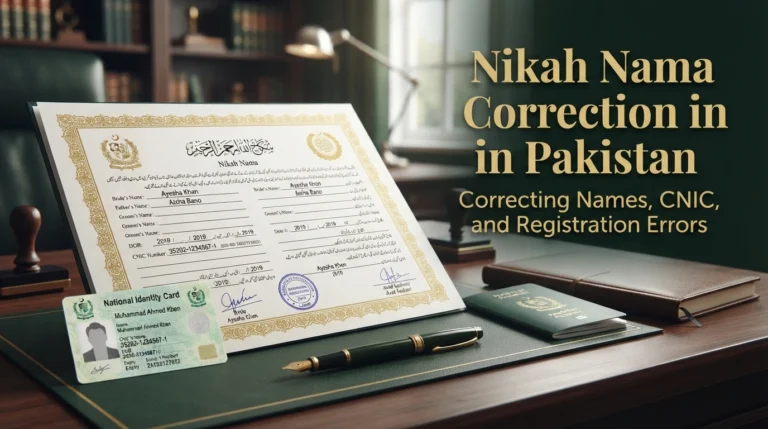
The prescribed Form II under the West Pakistan Rules made under the Muslim Family Laws Ordinance, 1961 contains a designated entry for witnesses to the marriage, traditionally numbered 11. It asks for their names, fathers’ names and residences. The relevant local version and actual printed form should be checked because administrative formats can vary.
A registrar who records incomplete witness information may leave the parties with avoidable difficulty proving the ceremony or obtaining official copies. Names should match the identity records used. The physical signatures should only be placed after the contents of the form have been reviewed.
Official source: West Pakistan Rules under the Muslim Family Laws Ordinance, 1961 — Form II.
Witnesses to a Vakil Appointment Are a Different Entry
The same prescribed Nikah Nama form separately addresses the bride’s appointed vakil, if one is used, and the witnesses to the appointment of that vakil. It also contains corresponding provisions for the groom’s representative, if applicable.
A vakil is an authorised representative; the appointment should be real, voluntary and within the permitted scope. A witness who can speak to the appointment of a representative is not automatically proof of every fact concerning the marriage ceremony. This distinction matters particularly when a party is absent and representation is proposed.
Do not fill representative or witness columns mechanically. If a column is inapplicable, follow the competent registrar’s current instructions and preserve a clear record rather than inventing names or signatures.
Sunni and Shia Rules Require Careful Distinction
For a Sunni Nikah, classical legal rules commonly discuss the presence and competency of witnesses, with differences between schools concerning their number and qualifications. An advocate and competent religious officiant should check the school applicable to the parties and the form of the actual ceremony.
In Ja’fari (Shia) jurisprudence, witnesses are generally not treated as a constitutive condition for the validity of a Nikah in the same way as in some Sunni approaches. That does not remove the separate obligation to comply with Pakistan’s applicable statutory marriage-registration framework. Neither the registrar nor a website should erase these distinctions by stating an absolute one-size-fits-all rule.
If the couple comes from different schools or there is uncertainty, obtain appropriate religious and legal advice before fixing the ceremony format.
Identity, Capacity and Reliability of Witnesses
The parties should select credible people whose identities can be verified and who can accurately state what they personally observed. An available CNIC or other lawful identification can assist correct recordkeeping, but an identity card should not be treated as a substitute for personal knowledge of the ceremony.
A witness should never sign a blank form or attest an event that they did not observe. Check spelling, parentage and addresses before signing. A false or unreliable entry can create difficulties years later during inheritance, overseas visa applications, marital-status disputes or evidence in family proceedings.
Who Conducts the Ceremony and Who Registers It?
A Nikah Khawan is the person who solemnises the ceremony; a licensed Nikah Registrar has a statutory role in the official registration process. Sometimes the same individual performs both roles, but the roles should not be assumed identical.
Section 5 of the Muslim Family Laws Ordinance, 1961 requires registration of Muslim marriages in accordance with the Ordinance. It also provides for licensed registrars and the reporting of a marriage solemnised by someone other than the licensed registrar. The complete record and delivery of copies are controlled by prescribed rules and local procedures.
Official source: Muslim Family Laws Ordinance, 1961, section 5.
Which Details Should Be Verified on the Nikah Nama?
Review the following details carefully before signing:
- Bride and groom’s names
- Parentage, age and identity particulars
- Earlier marital status
- Date and place of marriage
- Dower amount
- Prompt and deferred dower division
- Signatures
- Vakil details, where applicable
- Witness details
- Person solemnising the marriage
Special conditions and delegation of the right of divorce are separate legal issues and should not be skipped or filled by assumption.
Read the Pakistani Nikah Nama guidance alongside the actual official form. A mistaken spelling or omitted entry is easier to prevent than to correct later.
A pre-ceremony checklist should be tailored to the couple’s particular circumstances. No routine “magistrate marriage certificate”, medical certificate or parental approval letter should be advertised as a universal precondition for two consenting adults.
What Happens After Signing the Nikah Nama?
The completed document must follow the appropriate reporting and registration process. The signed Nikah Nama is the marriage contract and evidence of the event; the computerised Marriage Registration Certificate (MRC) is a different administrative certificate issued through the competent local registration authority.
An MRC is not ordinarily “issued by NADRA” merely because NADRA’s civil-registration technology supports the system. The issuing authority may be a Union Council, Cantonment Board or other competent local body depending on the jurisdiction.
Keep the signed copies and ask the registrar how and where the final official record will be preserved.
For problems involving an existing document, see our lost Nikah Nama and certified copy guide.
Witness Issues in Online and Proxy Nikah Arrangements
A video call does not itself decide whether an online or proxy Nikah is religiously valid or properly registrable. The couple’s personal law, consent, method of offer and acceptance, representative’s authority, evidence of identity and local registration practice must be considered together.
Do not assume that a screenshot of a video call or an unverified electronic signature is equivalent to a properly executed, registrable form. Where one person is overseas, identify the intended venue and recording authority before arranging witnesses or paying any fee.
Our Nikah services in Karachi page describes a local service context, but overseas arrangements need individual confirmation rather than a generic promise of instant registration.
Fees and Practical Timeline for a Witness-Ready Nikah
The firm’s professional fee depends on document preparation, whether an officiant and licensed registrar are required, city, venue, urgency and any overseas representation. Official fees are separate and should be identified from the responsible authority when applicable.
There is no responsible promise that every marriage will be concluded or registered within a fixed number of hours. Incomplete identification, disputed previous marital status, unsuitable witnesses or uncertainty about representation can change the required process.
A careful review before the ceremony is usually more helpful than a rushed correction afterwards.
Frequently Asked Questions About Nikah Witnesses in Pakistan
Religious requirements differ across schools of Muslim jurisprudence. A blanket statement covering Sunni and Shia marriages would be misleading. The couple should obtain advice applicable to their school and ensure the civil registration record is completed lawfully.
Yes. The prescribed Form II includes a designated entry for the names and identifying particulars of witnesses to the marriage, traditionally numbered 11. Check the current local form and registrar’s instructions.
A person should not attest an event they did not witness. The actual method of solemnisation and any representation arrangements must be reviewed; false witness entries create serious evidence problems.
Identity verification is important for reliable documentation, but the exact acceptable records and religious competence of a witness depend on the applicable requirements. The registrar should confirm the documentation they need.
Not necessarily. The prescribed form separately records witnesses to a representative’s appointment and witnesses to the marriage. Each entry should reflect the specific fact the person can truthfully attest.
The answer depends on the applicable personal law, actual consent, roles and any disqualifying conflict. Do not assume a family relationship alone makes an appointment valid or unnecessary.
Do not leave material fields to be completed with invented or unverified details. Review the entire form at the proper stage and follow lawful registration procedures for any genuine omission.
No. The Nikah Nama records the contract and ceremony. The MRC is an administrative marriage-registration certificate issued by the competent local authority after the required record process.
Potentially. Identity, consent, representation, religious rules and the registrar’s ability to accept the documentary record must all be checked in advance. A video link alone does not resolve every requirement.
Use CourtMarriage.com.pk's verified Pakistan Legal Helpline (WhatsApp) link. Give the city, ceremony type, intended date and whether a party will be represented. Do not send sensitive documents to an unverified personal number.
Arrange a Properly Documented Nikah
Nikah witness requirements in Pakistan deserve informed religious guidance and a carefully completed statutory record. CourtMarriage.com.pk can review your proposed ceremony, identity documents and registrar arrangements before any fee commitment. Use the site’s existing Pakistan Legal Helpline (WhatsApp) button for verified contact and document-handling instructions.
General educational information. Personal law, provincial age legislation and registration instructions can differ. This guide does not certify the validity of a particular ceremony.