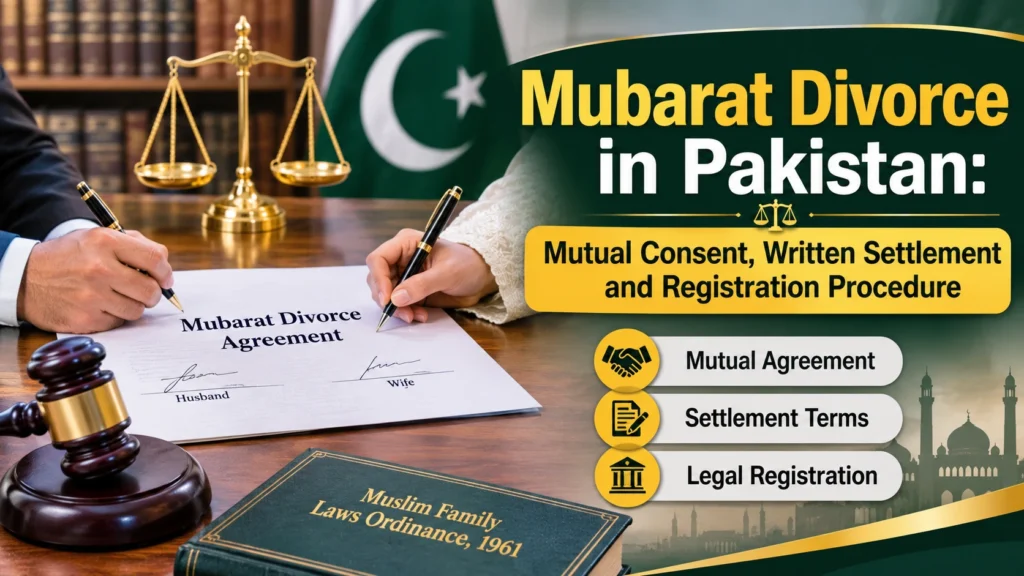
Mubarat Divorce in Pakistan: Mutual Consent, Written Settlement and Registration Procedure
Executive Summary: Mubarat Divorce in Pakistan
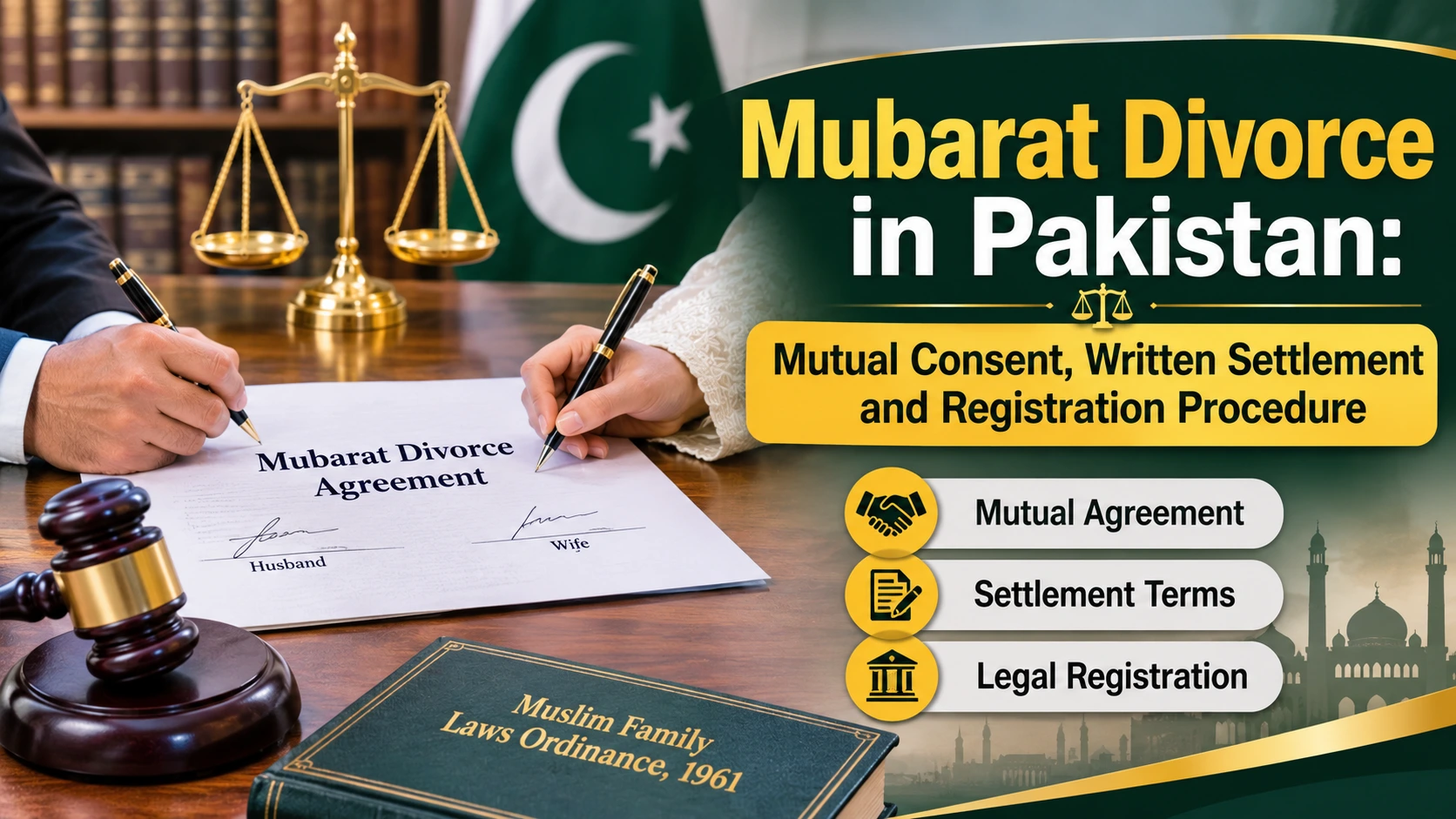
Mubarat divorce in Pakistan is a form of dissolution initiated by mutual agreement between spouses who wish to end their marriage. It is distinct from a husband’s unilateral talaq and from judicial khula proceedings. A mutual decision must still be recorded carefully, and the parties should consider statutory notice requirements, the effective date of dissolution, dower, maintenance, custody and any outstanding property or financial claims. A private signature alone should not be represented as automatically completing every legal and administrative requirement.
Section 8 of the Muslim Family Laws Ordinance, 1961 addresses dissolution otherwise than by talaq and applies section 7, so far as applicable, to such dissolution. The actual notice, reconciliation and record procedure should be confirmed with the competent Union Council, Arbitration Council or other relevant authority and a locally practising advocate. A stated 90-day statutory period under section 7 is not an automatic certificate-delivery promise and pregnancy may affect the applicable effective-date rule. Proceedings, evidence and local implementation can differ.
Court Marriage Pakistan offers lawyer-assisted review of mutual-divorce terms, drafting and guidance on the competent registration route. Legal fees depend on the drafting scope, underlying disputes and authority requirements; request a written quotation before engagement. Use the current verified website contact details to submit the marriage record, identity information and proposed agreement. The firm’s national Karachi office descriptions are Office 1 — DHA Phase 7, Karachi, and Office 2 — Gulistan-e-Jauhar, Karachi.
What Mubarat Means Under Pakistani Muslim Family Law
Mubarat is understood in Muslim personal-law discussions as dissolution by mutual release or agreement between spouses. Unlike khula, in which a wife ordinarily seeks dissolution through agreement or judicial relief, mubarat rests on both parties consenting to end the marital relationship. That distinction matters because the documentation must show free, informed agreement rather than merely an unaccepted proposal or a one-sided notice.
The fact that two spouses want an amicable separation does not resolve every legal question. An advocate should consider the terms of their marriage, any existing court order, pending family case, applicable school of personal law and the local registration requirements. Avoid preprinted statements suggesting that all religious communities use the same mechanism or that every marital dispute can be resolved through mubarat.
Agreement Must Be Free, Clear and Capable of Proof
A reliable agreement identifies the parties and their marriage, records the unequivocal consent of each spouse and states the agreed dissolution terms. A lawyer should check identity documents, the original or certified Nikah Nama, any marriage-registration record and whether either spouse is signing through a properly authorised representative. Misleading witnesses, missing pages or disputed signatures may cause serious problems later.
If one spouse is absent or overseas, the advocate must verify the legal adequacy of any proposed authorisation, remote documentation and attestation. Neither a video call nor a stamped sheet automatically proves valid consent. The drafting process should allow the parties to ask questions and receive advice without improper pressure from relatives or other intermediaries.
Mubarat Divorce, Khula and Talaq: Key Differences
The appropriate mechanism depends on who seeks dissolution, whether the other spouse agrees and whether judicial intervention is required. These mechanisms should not be treated as interchangeable labels in an application, legal notice or online advertising. The correct route can affect the supporting documents, terms and administrative record the parties need afterwards.
Route | Typical legal character | Points requiring separate advice |
Mubarat | Mutual agreement to dissolve marriage | Clear bilateral consent, settlement terms, statutory notices and records |
Talaq | Pronouncement by husband, subject to applicable law | Notice and reconciliation requirements under section 7, effective date and records |
Khula | Dissolution sought by wife, often through Family Court | Court decree and statutory post-decree steps; financial consequences depend on the case |
Talaq-e-Tafweez | Exercise of delegated divorce authority, where validly conferred | Nikah Nama delegation terms, procedure and section 8 application |
The table is a practical distinction, not a comprehensive rule for every sect or jurisdiction. A marriage involving another legal system, foreign residence or contested personal-law issues deserves an individual opinion rather than a generic template.
Legal Framework for Mutual Dissolution and Notice
Section 8 of the Muslim Family Laws Ordinance, 1961 refers to a wife exercising a duly delegated divorce right and to either party wishing to dissolve the marriage otherwise than by talaq. It states that the provisions of section 7 apply, so far as applicable and subject to context, to those forms of dissolution. This is why a mutual settlement and administrative notice should be assessed together.
Section 7 sets out a written notice and reconciliation framework for talaq, including a ninety-day period from the delivery of notice to the Chairman in the ordinary case. A practitioner should confirm how the competent authority applies those provisions to the particular mubarat documents. Do not advertise “instant legal divorce certificates” merely because the parties have signed the agreement.
Identifying the Competent Local Authority
The location of the original marriage, parties’ residence, relevant Union Council area and earlier matrimonial records can influence the proper administrative channel. Authorities and practice may differ between provinces and Islamabad Capital Territory. A Karachi couple should not automatically submit documents to an Islamabad office simply because a website offers remote drafting.
Before submitting papers, confirm the authority’s jurisdiction, document checklist, format, receiving officer and acknowledgement procedure. Keep a copy of the delivered notice and proof of receipt. Where a registrar, local council or arbitration forum issues records, it is important to identify the actual issuer rather than credit NADRA with issuing a local marriage or divorce document.
Effective Date, Reconciliation and Pregnancy
A legally competent adviser should calculate the effective date based on the specific mechanism and relevant statutory provisions, not simply the date typed at the top of a settlement. Under section 7, pregnancy can affect the timing rule in applicable cases. The fact that the spouses live apart does not establish that every notice, reconciliation and record requirement was met.
The adviser should also check whether any procedural steps are already underway, including notices previously delivered or court proceedings. Parallel documents with inconsistent dates can complicate inheritance, remarriage, immigration and identity-record matters. Parties should preserve the complete chronology and avoid retroactively changing the dates in executed papers.
Financial Terms of a Mubarat Settlement
The most difficult questions may concern dower, jewellery, gifts, household goods, personal belongings, loans and maintenance. Each should be identified separately. A vague sentence saying that both spouses have “no future claims” may create arguments over whether an item was knowingly addressed, whether a right could lawfully be released and whether the terms were obtained through improper influence.
A useful settlement distinguishes dower already paid from deferred dower, identifies property that each spouse owns and lists any agreed transfer or instalment. Receipts and custody of documents should be recorded. The drafting lawyer must check whether a proposed waiver is permissible and genuinely voluntary; the amount and legal consequences cannot be assumed from a standard template.
Dower, Jewellery and Return of Personal Property
A Nikah Nama may specify prompt and deferred dower. Jewellery may be a bridal gift, dowry article, entrusted property or an item belonging to another person. An advocate must not classify all jewellery as refundable dower simply because the relationship ends. The actual ownership evidence, delivery record and settlement terms matter.
If the parties agree that particular articles will be handed over, use a dated inventory and signed acknowledgement. For items that cannot be located, record the agreed treatment instead of asserting a replacement value without evidence. Disagreements over property should be separately documented even when the spouses agree on dissolution.
Children: Custody, Visitation and Maintenance
Mutual divorce does not extinguish a child’s independent welfare interests. Parents can propose residence, schooling, healthcare, holidays, contact schedules and financial support, but those terms remain subject to applicable law and the competent court’s welfare assessment. A private clause purporting permanently to exclude a parent’s lawful contact or erase a child’s entitlement may not be enforceable merely because both adults signed it.
A workable parenting arrangement states how and where children will be handed over, how travel will be coordinated and what happens when health or examination schedules interrupt meetings. If the parents have an existing custody or visitation order, the new document should be checked for consistency and any necessary court variation.
Overseas Parents and Travel Documents
When a child or spouse is living overseas, consider passport custody, travel consent, foreign-nationality issues and existing Pakistani or foreign court orders. The parties should not assume that a notarised mutual-divorce agreement automatically authorises international relocation or modifies a court’s custody directions. A jurisdiction-specific assessment may be necessary before anyone buys tickets or releases travel documents.
Foreign immigration or consular requirements may call for verified translations, attestations or separate proof of marital status. Confirm the actual receiving authority’s checklist. A lawyer should avoid promising that a particular Pakistani certificate alone guarantees recognition in another country.
Documents to Assemble Before Drafting Mubarat
Collect legible identity documents for both spouses, the Nikah Nama and any available local marriage-registration certificate, current addresses, reliable contact details and proof of any earlier notice or court proceeding. For financial settlement, include payment receipts, dower records, property inventories and relevant written communications. If children are involved, gather their documents and existing family-court orders.
The original papers should remain secure while review copies are prepared. Do not alter a certificate, replace a date or add a missing signature without a proper lawful procedure. Where the spouses disagree about a key item, the adviser should mark that issue as unresolved rather than producing a falsely comprehensive agreement.
Suggested Settlement and Filing Checklist
Record or decision | Why it matters |
Nikah Nama and identity papers | Establish parties, marriage and original terms |
Clear mutual consent | Distinguishes bilateral dissolution from unilateral acts |
Dower and property schedule | Reduces ambiguity about what has been retained or transferred |
Child arrangements | Provides a practical welfare-focused proposal where relevant |
Notice and acknowledgement | Preserves the applicable statutory and administrative chronology |
Certificates and certified copies | Supports later proof of status when properly issued |
Drafting, Notice and Record Verification: Practical Steps
First, obtain legal review of the marriage and the parties’ decision. Second, prepare a precise settlement stating what each spouse actually agrees to. Third, review the document with each party and arrange lawful execution and identification. Fourth, submit any required notice or supporting papers to the competent authority and retain acknowledgement. Fifth, follow any applicable reconciliation or statutory timeline and obtain the correct official record when eligible.
None of these stages should be advertised as guaranteed to finish on a fixed day. Errors in identity information, missing marriage records, disputed consent or the wrong authority can require correction. The lawyer’s written engagement scope should say whether it covers drafting only, notice submission, follow-up, family-court proceedings or obtaining certified copies.
Mubarat Divorce Fees, Timing and Legal Assistance
Professional fees should reflect the actual work: agreement review, drafting, consultation with both parties, document verification, advice on council procedure and any follow-up. Official charges, if applicable, must be identified separately using the relevant authority’s current schedule. There is no sound basis for a universal fee or unconditional completion-time claim across Pakistan.
Court Marriage Pakistan can assist with a written scope, document checklist and referral to the appropriate proceedings where mutual consent fails. Start through the site’s current verified WhatsApp contact, identify the city and provide the documents securely. For a Pakistan-national page, Karachi service locations may be described briefly as Office 1 — DHA Phase 7, Karachi and Office 2 — Gulistan-e-Jauhar, Karachi; do not add unverified unit numbers or staff direct lines.
Frequently Asked Questions About Mubarat Divorce in Pakistan
1. Is Mubarat the Same as Khula in Pakistan?
No. Mubarat is based on mutual agreement between spouses, whereas Khula may involve Family Court proceedings when mutual agreement is not reached. The appropriate legal procedure depends on the circumstances of the marriage and the relief being sought.
2. Can One Spouse Execute a Mubarat Deed Without the Other Spouse’s Consent?
No. A unilateral document cannot establish a genuinely mutual Mubarat arrangement. Both spouses’ consent and the appropriate legal mechanism must be assessed separately.
3. Does Signing a Mubarat Agreement Mean the Divorce Is Immediately Registered?
Not necessarily. Signing a Mubarat agreement does not, by itself, establish that all statutory requirements have been completed. Applicable notice, reconciliation and registration requirements should be confirmed with the competent authority.
4. Does the 90-Day Divorce Rule Always Apply in the Same Way to Mubarat?
No blanket assumption should be made. Section 8 of the Muslim Family Laws Ordinance, 1961 applies section 7 so far as applicable to other forms of dissolution of marriage. The specific notice procedure, relevant dates and any pregnancy-related timing should be reviewed according to the circumstances.
5. Must a Wife Return All Gifts or Jewellery After Mubarat Divorce?
Not automatically. The legal position depends on ownership, whether an item forms part of dower, the nature of the property and any valid settlement terms voluntarily agreed between the spouses. Each item should be assessed individually.
6. Can Parents Permanently Waive a Child’s Maintenance in a Mubarat Agreement?
A private agreement cannot automatically extinguish a child's independent lawful entitlements. Child maintenance arrangements remain subject to the child's welfare and the applicable family-law framework.
7. Can a Mubarat Settlement Change an Existing Child Custody Order?
A private Mubarat settlement does not automatically replace or vary an existing court order. Where custody or visitation arrangements need to change, the appropriate legal procedure should be followed with regard to the child's welfare.
8. Is Notarisation Alone Sufficient for Overseas Recognition of Mubarat Divorce?
No. Notarisation alone may not satisfy the requirements of a foreign authority. Depending on the receiving jurisdiction, additional certificates, official records, translations, attestations or other supporting documents may be required. The relevant foreign authority's requirements should be confirmed.
9. What Happens If Spouses Disagree About Dower After Signing a Mubarat Agreement?
The agreement's exact wording, supporting evidence, validity of consent and available legal remedies should be reviewed. Unclear or broadly worded dower-release clauses may create further disputes, so financial settlement terms should be precise.
10. What Is the First Step to Obtain a Mubarat Divorce Document Review?
The first step is to arrange a review of the Nikah Nama, identity documents, proposed settlement terms and details of any children or existing court orders. These documents should be shared with a qualified family-law adviser through the website's verified contact channel.
Legal Review and Source References
A lawyer-led examination should determine whether mutual dissolution is genuinely suitable, identify any unresolved financial or child-welfare matters and verify the competent authority and dates. Ask for the fee basis in writing; do not rely on claims of automatic registration or guaranteed foreign recognition.
Primary legal sources:
Lorem ipsum dolor sit amet, consectetur adipiscing elit. Ut elit tellus, luctus nec ullamcorper mattis, pulvinar dapibus leo.