Widow Remarriage in Lahore | Nikah Documents and Registration Guide
Executive Summary: A Fresh Marriage After Bereavement
Widow Remarriage in Lahore is a lawful personal decision that should be handled with dignity, clear marital-status evidence and careful compliance with the applicable Muslim personal-law and marriage-registration requirements. A widow does not lose the right to choose a future spouse merely because she was previously married or has children. A new Nikah, however, is a separate marriage with its own consent, witnesses, dower and registration record.
A professional legal review can help the couple check the first husband’s death records, the applicable waiting period, identity documents, the authorised Nikah Registrar and the entries to be made in the fresh Nikah Nama. Service charges and official costs should be confirmed by written quotation and current local rules. A genuine marriage ceremony is different from the later issue of a Marriage Registration Certificate; neither can be guaranteed by an invented deadline.
Is Widow Remarriage in Lahore Legally Permitted?
Widow Remarriage in Lahore is not prohibited simply because a woman was previously married. For a Muslim marriage, the parties must satisfy applicable personal-law requirements, including free consent, legal capacity and the relevant waiting period after the earlier marriage ended by death. The precise circumstances, school of law and any exceptional legal issue should be reviewed rather than assumed from a generic internet checklist.
Social pressure from relatives should not be confused with a legal requirement for them to choose a spouse. Likewise, an adult competent woman’s decision must not be replaced by an advocate’s or service provider’s judgment. Where coercion, threats, a disputed identity or a contested earlier marriage is alleged, obtain case-specific legal advice before proceeding.
The Widow’s Right to Make an Independent Marriage Decision
A widow’s previous marriage does not permanently prevent her from choosing another spouse. Her decision should be voluntary and based on her own understanding of the proposed marriage.
Relatives may offer advice or support, but their preferences should not be presented as an automatic legal permission requirement. If there are threats, coercion or a genuine dispute about legal capacity, those circumstances should be examined separately.
The Waiting Period After the Husband’s Death
The post-bereavement waiting period, commonly called iddat or iddah, depends on the relevant Muslim personal-law rules and circumstances, including pregnancy. Its calculation and completion should be reviewed against the actual date of death and the applicable religious/legal position. A standard appointment date should never be offered without checking that the proposed marriage is permissible.
For many Muslim women whose husbands have died, the commonly stated waiting period is four lunar months and ten days. Pregnancy can affect the calculation, and the applicable school of law should be checked before relying on a general statement. The relevant religious basis includes Quran 2:234 and the pregnancy provisions considered alongside Quran 65:4.
The date of death, pregnancy status and applicable personal-law interpretation should therefore be considered together. A couple should not treat an estimated calendar date as a substitute for an individual assessment.
Consent, Capacity and an Accurate Record
Both prospective spouses should understand the intended Nikah and any material contractual terms. The registrar and Nikah Khawan should confirm identity, capacity, agreed dower and required witnesses. Court Marriage Pakistan should not describe an affidavit as a substitute for these elements or claim a magistrate’s certificate is what creates a Muslim marriage.
The bride and groom should have an opportunity to understand and agree to:
The identity of the intended spouse.
The proposed marriage and its terms.
The agreed Haq Mehr.
Any additional lawful marriage conditions.
The information recorded in the Nikah Nama.
The information should be entered accurately, and neither party should be pressured into signing a document they do not understand.
Widow Remarriage in Lahore: Essential Documents to Review
A document pack should establish the woman’s identity and the end of her earlier marriage. The death certificate or certified death record should be obtained through the legally competent authority; the relevant local body, including Union Council or Cantonment Board where appropriate, maintains the applicable civil registration process. NADRA-linked registration infrastructure must not be confused with the authority that issues each underlying certificate.
Record | Why It May Be Needed |
|---|---|
Bride’s and groom’s current CNICs or accepted identity documents | Correct names, ages and identifying entries |
Deceased husband’s death certificate or competent record | Evidence that the previous spouse has died |
Earlier Nikah Nama or marriage record, if available | Reconcile prior names and identity history |
Witness identity records | Confirm required witnesses and accurate entries |
Agreed dower details and other lawful terms | Avoid ambiguous or incomplete Nikah Nama columns |
Existing child or inheritance documents, if material | Keep separate property and family matters clear |
The precise documents accepted by the local authority should be checked in advance. The absence of an old marriage certificate may require reconstruction from records, but it is not a licence to invent a spouse’s death or alter an existing record.
Widow Remarriage in Lahore can be delayed by spelling differences, outdated CNIC particulars or a disputed death entry, so verification before the ceremony is sensible.
What If the Previous Nikah Nama Is Unavailable?
If the earlier Nikah Nama cannot be located, the couple should explain the circumstances and check what alternative records can establish the relevant marital history.
The appropriate authority may need to verify existing registration records or consider a certified copy where available. Missing documents should be addressed through legitimate record-retrieval procedures rather than fabricated statements or informal alterations.
How to Arrange Widow Remarriage in Lahore Step by Step
A properly documented process helps reduce avoidable mistakes and protects the accuracy of the new marriage record.
Step 1: Obtain confidential instructions from both adults.
Check that the decision is voluntary and that both prospective spouses understand the intended marriage.
Step 2: Review identity and previous marriage records.
Check the current identity documents and obtain evidence of the first husband’s death.
Step 3: Establish that the applicable waiting period has been completed.
Consider the date of death, pregnancy status and applicable personal-law requirements.
Step 4: Choose a competent Nikah Khawan and understand the registration route.
Confirm which authorised Nikah Registrar will record the marriage and which local authority is responsible for the registration process.
Step 5: Agree the terms of the fresh marriage.
Discuss the Haq Mehr and any lawful additional conditions before the parties sign the Nikah Nama.
Step 6: Conduct the Nikah.
Complete the required offer, acceptance and witnesses according to the applicable form of Muslim law.
Step 7: Complete marriage registration and obtain the appropriate copies.
Ensure the authorised Nikah Registrar records the marriage correctly and that the parties receive the appropriate copies.
A lawyer’s role is to explain the procedure and preserve the record, not to create false declarations to overcome an obstacle.
Widow Remarriage in Lahore should never be presented as a process that requires a fictitious court hearing, a routine medical certificate or a compulsory parental no-objection letter for every legally competent adult woman.
Who Registers a Fresh Nikah in Lahore?
Section 5 of the Muslim Family Laws Ordinance, 1961 provides for registration of marriages solemnised under Muslim law. The statutory framework refers to Union Council licensing of Nikah Registrars and reporting marriages not solemnised by a registrar for registration. The applicable local administrative arrangements and form-prescribed procedure must be checked where the marriage actually occurs.
The Nikah Nama is the primary marriage contract and registration document. A computerised Marriage Registration Certificate may be obtained from the competent local authority through the prescribed process.
According to the Punjab Local Government and Community Development Department, the Nikah Khawan arranges registration with the Nikah Registrar within whose jurisdiction the marriage is solemnised, while the concerned Union Council or Municipal Committee issues the Computerised Marriage Registration Certificate.
NADRA’s CRMS or related system processes registration data; it should not be casually presented as the sole authority issuing every marriage certificate. These distinctions matter for later identity, family and overseas documentation.
Lahore Registration and Cantonment Area Considerations
The relevant registration route should be identified according to where the Nikah takes place and which local authority has jurisdiction.
For ordinary Union Council or Municipal Committee areas, the concerned local authority’s procedure should be checked. Cantonment Board cases may follow the relevant Cantonment Board registration process.
The Punjab government’s e-Khidmat information also distinguishes Cantonment Board cases from other district cases for marriage-certificate processing.
E-Khidmat Markaz
Widow Remarriage in Lahore and the Nikah Nama Columns
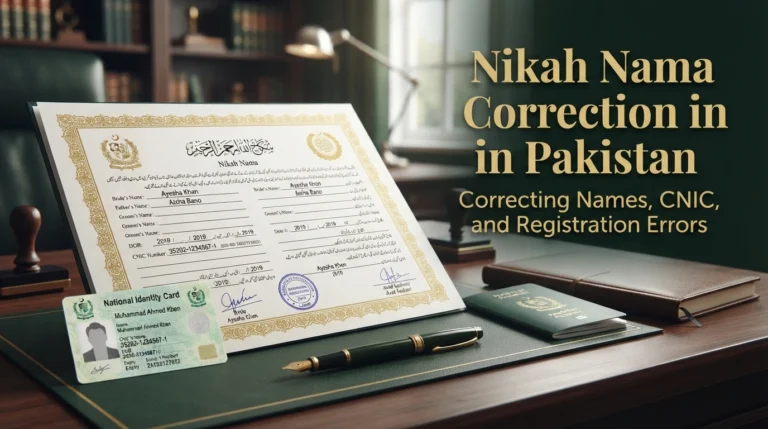
A new marriage requires a fresh Nikah Nama. The parties should check every entry instead of carrying forward particulars from the earlier marriage. Record the bride’s legal name and identity carefully, identify the groom and witnesses correctly, and enter the agreed Haq Mehr as required. A poorly documented dower arrangement can cause avoidable disagreements later.
Widow Remarriage in Lahore also raises a practical question about marital status: the registrar should use the prescribed form accurately, supported by available records, rather than inserting an arbitrary description. Any additional lawful marriage conditions should be discussed before signatures. Copies must be legible, consistent and obtained through the recognised registration process.
The parties should pay particular attention to:
Bride’s full legal name and identity details.
Groom’s full legal name and identity details.
Relevant marital-status particulars.
Witness names and identifying information.
Agreed Haq Mehr and payment terms.
Additional lawful conditions, where applicable.
Signatures and other prescribed entries.
Punjab’s amendment to the marriage-registration framework includes requirements concerning accurate completion of Nikah Nama columns. The current applicable form and rules should be checked by the registrar rather than relying on an incomplete online template.
Adalat Online
Children, Guardianship and Inheritance After Remarriage
If the widow has children from the deceased husband, a fresh marriage does not by itself settle guardianship, custody or inheritance questions. Those rights depend on separate facts and relevant law. The deceased husband’s estate, the widow’s share and children’s entitlements should be considered independently of the new husband’s property unless a legally recognised transaction changes ownership.
A service provider should never demand that a widow surrender inherited property or sign a release as a routine condition of remarriage.
If there is a pending family case, guardianship order or property dispute, take specific advice. Widow Remarriage in Lahore should be documented without allowing unrelated family pressure to dictate property or custody decisions.
Keep Inheritance and New Marriage Records Separate
The deceased husband’s estate and the new marriage are separate legal matters. Any inheritance distribution, transfer, relinquishment or property settlement should be examined independently.
The parties should not assume that remarriage automatically transfers inherited assets to the new spouse or extinguishes children’s existing rights.
Is a Court Appearance Required for Widow Remarriage?
The phrase “court marriage” is frequently used in Pakistan for an adult couple’s consensual marriage arranged with legal documentation. A Muslim Nikah is not created merely by obtaining an affidavit or standing before a court building.
The ceremony and its legal prerequisites must be fulfilled; affidavits may be relevant evidence in some circumstances, but they do not replace a Nikah.
A notary’s attestation also cannot cure missing consent, witnesses or a false marital-status declaration. If the couple faces intimidation or threatened violence, an advocate can assess lawful protective remedies separately. Such remedies are fact-specific and must not be marketed as a guaranteed shield from every police or family complaint.
For a broader explanation of the documentation process, readers may also consult the Court Marriage in Pakistan: Procedure and Fees guide.
Common Difficulties in Widow Remarriage in Lahore
A death certificate may contain a different spelling of the late husband’s name, the older Nikah Nama may be unavailable, or the woman’s identity card may still show details that are being updated. These problems call for proper record reconciliation, not backdating or using another person’s documents. The registrar should be told about genuine discrepancies before signing.
Other difficulties include:
A disagreement about the waiting period.
A proposed marriage to a person with an existing marriage.
Children whose guardianship is contested.
Differences between CNIC and previous marriage records.
An unavailable or incomplete death registration record.
Unclear responsibility for registration in a particular locality.
Each topic has its own legal requirements. Widow Remarriage in Lahore should never be treated as an exception to the generally applicable marriage-capacity, registration or polygamy rules simply because one spouse is bereaved.
Fees, Confidentiality and Responsible Lahore Service
Costs can include document retrieval, registrar-related prescribed charges and any agreed professional services. Ask for an itemised written quotation explaining what is included and what depends on the competent authority.
Avoid services that promise a fixed number of hours without checking the documents or that offer to issue a supposedly “NADRA marriage certificate” without any legitimate local registration.
Sensitive details about bereavement, children and prior family arrangements should be handled confidentially. Where a widow prefers to communicate directly with the legal team rather than through relatives, respect that instruction, subject to lawful identity and capacity verification.
The responsible goal of Widow Remarriage in Lahore is a genuine, accurately recorded marriage that protects both parties’ rights.
Frequently Asked Questions About Widow Remarriage
1. Is a widow allowed to marry again in Lahore?
Yes, subject to the applicable personal-law, legal-capacity and marriage-registration requirements.
2. Must a widow obtain permission from her late husband’s relatives?
There is no general rule that the deceased husband’s relatives own an adult widow’s choice of spouse. Specific disputes require independent advice.
3. Is the waiting period always the same?
No. It must be calculated under the applicable personal-law rules and circumstances, including pregnancy.
4. Is the deceased husband’s death certificate relevant?
Yes. Competent proof of death helps establish the end of the earlier marriage and accurate marital-status records.
5. Is a new Nikah Nama necessary?
Yes. A fresh Nikah should be properly documented and registered as a separate marriage.
6. Does a notary certificate replace a Nikah?
No. Notarisation of a paper does not substitute for the essential requirements of a Muslim marriage.
7. Does a widow automatically lose custody of her children if she remarries?
No universal automatic conclusion should be drawn. Any custody dispute is determined under the relevant law and child’s welfare.
8. Who issues the Marriage Registration Certificate?
The competent local authority under the applicable system, not simply any private agent claiming to act for NADRA.
9. Can we arrange a marriage without a courtroom ceremony?
The correct legal requirements concern a valid Nikah and its registration; a courtroom ceremony is not a universal prerequisite.
10. What if names differ between the CNIC and older records?
Resolve the discrepancy through the appropriate documents and authority rather than changing entries informally.
Legal Sources and Related Reading
Primary legal and administrative references