Second Marriage Permission in Pakistan | MFLO Section 6 Guide
Executive Summary: Second Marriage Permission in Pakistan
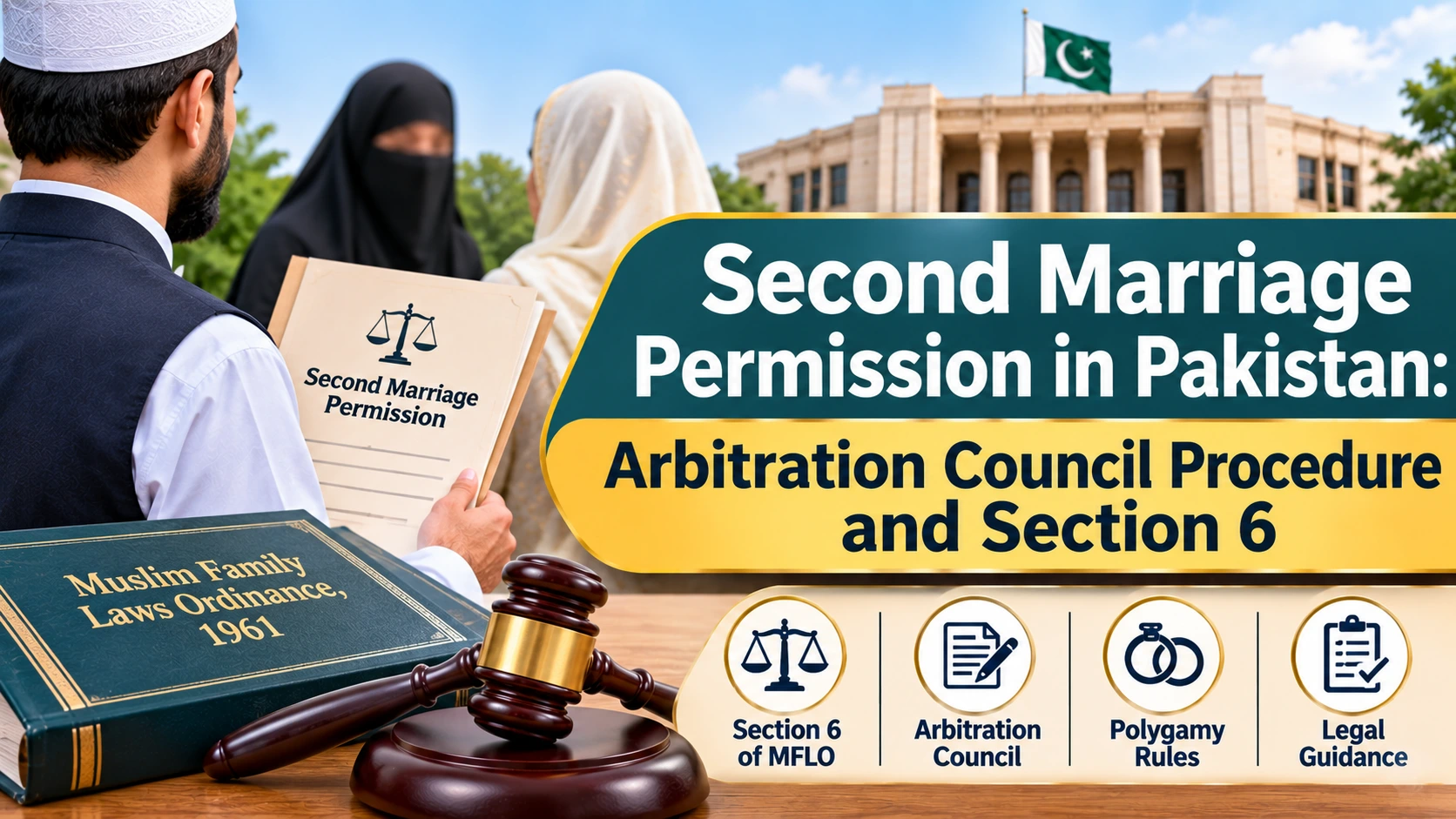
Second marriage permission in Pakistan is a statutory issue for a Muslim man whose first marriage is still subsisting. Section 6 of the Muslim Family Laws Ordinance, 1961, requires previous written permission from the Arbitration Council, subject to the applicable legal framework. A spouse’s informal verbal agreement is not the same document. Court Marriage Pakistan offers advocate-led review of marriage status, relevant Nikah Nama clauses, application requirements and record-based guidance before a proposed Nikah is arranged.
A valid advisory process starts by establishing whether an earlier marriage remains legally subsisting, rather than relying on hearsay that a divorce has taken place. Counsel then identifies the competent Chairman, the prescribed application and fee, the reasons asserted for the proposed marriage, and whether the existing wife or wives have consented. The Council considers the case through the procedure laid down by law; it cannot be assumed that approval is automatic because an applicant is financially comfortable or both families agree.
Service charges depend on document complexity, representation and location, and should be quoted in writing. Official charges vary and must be verified with the relevant authority. National enquiries may be directed through the site’s verified Pakistan Legal Helpline (WhatsApp). For Karachi service descriptions use only Office 1 — DHA Phase 7, Karachi; Office 2 — Gulistan-e-Jauhar, Karachi, not unverified street addresses.
What Does Section 6 of the MFLO Require?
Section 6 addresses polygamy during an existing marriage. The key statutory condition is advance permission in writing from the Arbitration Council, obtained before contracting another marriage. The application is made to the Chairman in the prescribed manner, with reasons for the proposed marriage and a statement whether consent has been obtained from existing wife or wives.
The Chairman asks the applicant and existing wife or wives to nominate representatives. The Council so constituted considers whether the proposed marriage is necessary and just and may impose lawful conditions. The decision must be reasoned. Procedures for revision and related consequences must be checked against the applicable statute and provincial amendments.
Consent of the First Wife and Written Council Permission Are Different
The law requires disclosure about the existing wife’s consent; it does not say that private consent alone replaces written Council permission. Equally, an existing wife’s objection is not a mechanical substitute for the Council’s statutory assessment. This distinction matters when clients arrive with a family letter, an affidavit or an oral assurance and assume the registration problem has been solved.
A client should therefore separate three questions:
- Whether consent was sought.
- What the application truthfully discloses.
- Whether the competent Council has issued written approval.
Every record must be genuine. Falsifying a consent document or presenting an inaccurate marital status can create additional civil or criminal risk.
Identify Whether the Existing Marriage Is Still Subsisting
An earlier Nikah is not necessarily over merely because spouses live separately or a husband has said he intends to divorce. Section 7 of the MFLO governs written notice of talaq to the Chairman and copy to the wife; its effectiveness provisions generally involve a statutory period subject to specific exceptions and amendments. A Family Court khula decree is another distinct route with its own legal and administrative records.
Before beginning a Section 6 application, counsel should examine the earlier Nikah Nama, any divorce notice and acknowledgement, reconciliation proceedings, decree, death certificate or other reliable document establishing the actual status. Where material facts are disputed, a quick online checklist is insufficient and specialised advice is essential.
Which Arbitration Council Has Jurisdiction?
The identity of the competent authority should be confirmed under the governing MFLO rules and the applicant’s specific circumstances. The expression ‘Arbitration Council’ here refers to the statutory body constituted under family-law provisions. It should not be confused with an ordinary private commercial arbitration or with a court issuing a generic permission letter.
Jurisdiction and local administrative practice can depend on address, marital records and applicable rules. Do not file blindly at a Union Council chosen solely for convenience. A properly prepared application will show why the designated Chairman is the correct authority, attach the necessary material and disclose any previously rejected or pending application.
Preparing a Second Marriage Permission Application
The applicant should gather identification, the existing Nikah Nama, accurate addresses, family-status records and a considered explanation of the proposed marriage. The prescribed form and fee must be checked locally. The application should be internally consistent with other documents and must not misstate consent, family relationships or the reasons advanced.
Where the existing wife or wives nominate representatives, those communications must be handled respectfully and in the correct process. The legal representative’s task is to present accurate documents and explain the statutory test, not to manufacture evidence or pressure a spouse. Copies of all notices, replies and orders should be kept securely.
Reasons, Fairness and Documentary Support
Section 6 directs the Arbitration Council to consider whether the proposed marriage is necessary and just. This is an evaluative decision, not a list of guaranteed qualifying reasons. The applicant’s explanation and the existing family’s position may both be material. Financial claims, where relied upon, should be supported by verifiable information rather than promises the applicant cannot realistically fulfil.
An advocate may help the client prepare a chronological statement identifying the existing marriage, current family responsibilities, reasons for the request and supporting records. It remains for the Council to decide under law. Different outcomes should be anticipated in advance so the applicant does not make irreversible arrangements prematurely.
Can the Nikah Be Registered Without Written Permission?
Section 6 expressly addresses registration of a further marriage contracted without the required previous permission. This creates a practical legal and administrative problem for an applicant who assumes that a Nikah ceremony, a private affidavit, a general court document or the presence of witnesses removes the statutory condition. A person should seek legal advice before solemnisation, not only after a registrar refuses an entry.
The consequences of a marriage contracted without permission should not be simplified into the unsupported assertion that every such marriage is automatically void. Questions of marital validity, registration, remedies and penalties require careful distinction and current case-law review. A registrar and legal adviser should not invent a backdated permission or certify compliance that did not occur.
Legal Consequences of Ignoring Section 6
Section 6(5) includes consequences for contracting another marriage without the required Council permission. It addresses immediate payment of dower due to existing wife or wives and penal liability on conviction following complaint, subject to applicable amendments. Provincial legislation may alter penalties and procedural details, so an old fine amount copied from a generic website may be unreliable.
Consequences are not limited to a single registration form. A resulting dispute may involve family finances, the dower claim, disclosure to a Nikah Registrar and litigation over the underlying facts. A separate question is what remedies are available to the existing spouse under applicable personal and family law. A lawyer should explain each remedy independently rather than suggesting one penalty resolves all claims.
What If the First Wife Has Agreed to the Second Marriage?
Written consent may be important evidence, but Section 6 still requires the statutory permission process. If the spouse has agreed, preserve an authentic record of the circumstances without claiming that the Council must approve. If the spouse has not agreed, accurately say so; the applicant cannot lawfully turn a disputed position into a fabricated declaration.
There is no safe shortcut through changing the district, using a different spelling of the groom’s name, or concealing the first Nikah. These approaches create inconsistent records that may later affect registration, dower and court proceedings. Full disclosure is both legally important and practically easier to defend.
Can the Arbitration Council Refuse Permission or Impose Conditions?
Yes. Section 6 contemplates a reasoned decision on whether the proposed further marriage is necessary and just, with appropriate lawful conditions where permission is granted. It also sets out a mechanism for revision, to be understood in the context of applicable rules and amendments. An applicant considering a challenge should obtain a certified copy of the order and consult counsel promptly.
The proposed Nikah should not proceed on the assumption that a pending application is equivalent to approval. A receipt showing that an application was filed is not a grant of written permission. The terms and identity of the authorised body must be examined before any legal representation to the Nikah Registrar.
How a Lawyer Can Assist With Second Marriage Compliance
An appropriate legal review can establish the documented status of the first marriage, identify the correct statutory authority, assess what must be disclosed, draft a complete application, organise supporting records and explain hearings or representation requirements. The professional role also includes advising where proceeding would expose the client or spouses to avoidable risk.
Court Marriage Pakistan should handle this as a legal-compliance service, not a guaranteed ‘second Nikah approval’ product.
For further information, read our related guides:
Frequently Asked Questions on Second Marriage Permission
1. Does a Muslim man need written permission for a second marriage in Pakistan?
Section 6 requires previous written Arbitration Council permission while an existing marriage subsists.
2. Is consent of the first wife enough on its own?
No. Consent and statutory written permission are legally distinct.
3. Does the Arbitration Council have to grant approval?
No. The Council assesses the statutory criteria and records reasons for its decision.
4. Can I apply if a divorce case is pending?
The status of the first marriage and any effective divorce must be established before advising.
5. Can an affidavit replace the permission order?
A private affidavit is not the Council’s written permission.
6. Is a filed application the same as approval?
No. A filing acknowledgement does not authorise a further marriage.
7. What information must the application disclose?
The prescribed application includes reasons and whether existing wife or wives consented, along with required records.
8. Does a marriage without permission become automatically void?
Do not assume automatic invalidity. Registration, validity and statutory consequences require separate legal analysis.
9. Is a single national penalty figure reliable?
No. Check the current law and applicable provincial amendments before quoting a penalty.
10. What should I do before arranging the second Nikah?
Verify marital status, the proper authority, prescribed documents and the actual written Council decision.