Pre-Nikah Legal Checklist in Lahore | Age & Registration 2026
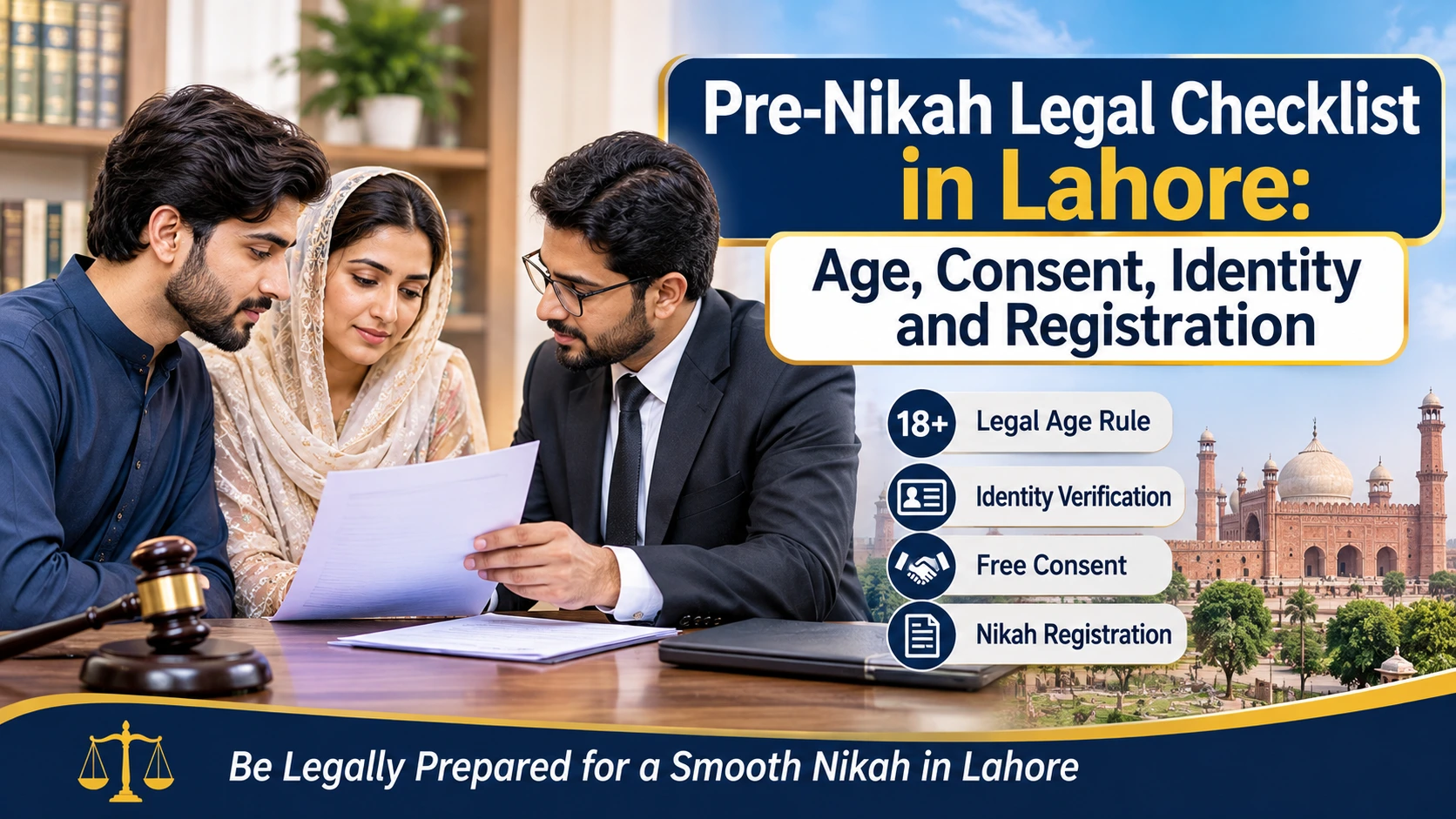
Pre-Nikah Legal Checklist in Lahore: The 2026 Age Rule
A pre-Nikah legal checklist in Lahore helps adult couples avoid preventable documentation errors, unlawful age assumptions and confusion between the religious ceremony and the official registration record. In 2026, one especially important change for Punjab couples is the provincial law requiring both parties to be at least eighteen. Couples should verify all material facts before arranging a Nikah Khawan, registrar, venue or witnesses.
Punjab introduced the Child Marriage Restraint Ordinance in February 2026. The Punjab Child Marriage Restraint Act, 2026 (Punjab Act XXVII of 2026) followed in May. The Act is recorded as assented to on 11 May 2026, came into force at once and replaced the earlier provincial framework. It defines a child as a person, male or female, who is under eighteen years of age. A child marriage includes a Nikah or marriage where either contracting party is under eighteen.
Accordingly, do not arrange a Lahore Nikah if either proposed spouse is under eighteen. A parent’s approval, an affidavit, an invitation card or a private religious assertion does not authorise a marriage prohibited by the Punjab law. The Act also prohibits a Nikah Registrar from registering a child marriage. Registrars, officiants, facilitators and families should check the current Act and applicable rules rather than rely on an old checklist quoting the previous age threshold.
The February ordinance was superseded by the May 2026 Act. It should not be described as the sole operative law. The official Punjab Local Government and Community Development laws page lists the May Act dated 11 May 2026.
Verify Each Adult’s Identity Before a Lahore Nikah
Ask each party to present a valid original CNIC or another legally acceptable identification document for the relevant process. Verify the full name, parentage, date of birth and identifying particulars against the information to be entered in the Nikah Nama. Do not guess missing digits or copy an unverified handwritten name.
Before the ceremony, check that:
The name is spelled consistently with the identity document.
The date of birth supports the legal age requirement.
The CNIC or other accepted identity document is valid and belongs to the person presenting it.
Parentage and other identifying details are accurately recorded.
Any difference between documents is explained and resolved before signing.
Where an overseas person has a NICOP or passport, ask the licensed registrar and relevant local authority what proof is acceptable. Distinguish evidence needed to establish identity from documents needed for a particular registration service. A passport or a birth record is not an automatic exemption from Punjab’s age requirements or the applicable registration rules.
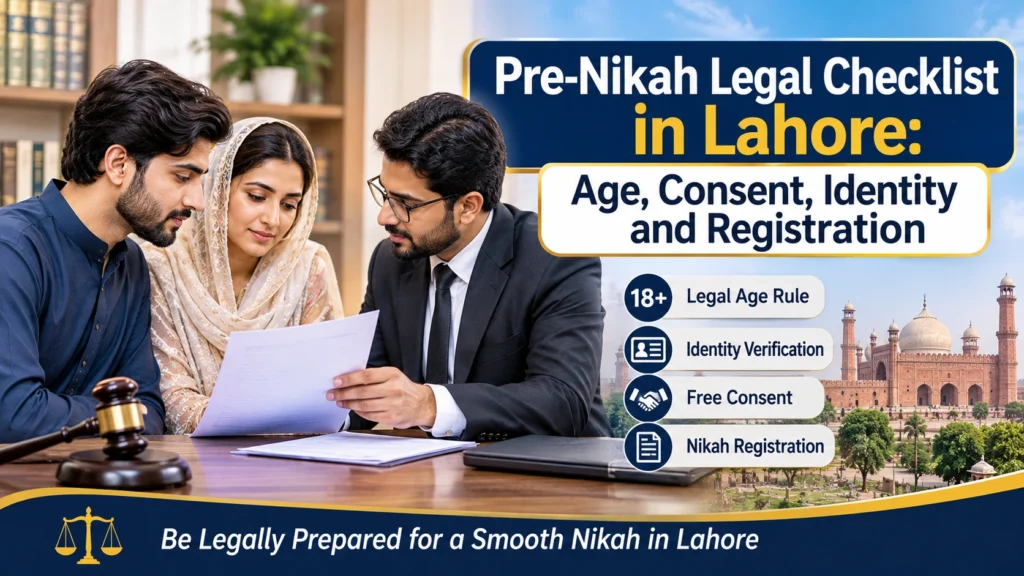
Pre-Nikah Consent Must Be Free and Independently Confirmed
A valid adult marriage requires genuine consent. Confirm privately that each proposed spouse understands whom they are marrying and has freely decided to proceed. If someone reports threats, violence, confinement, deception or pressure, stop the routine ceremony process and obtain qualified legal and safety assistance.
A free-will affidavit may provide useful evidence in an appropriate case, but it does not replace the marriage contract or cure an unlawful arrangement. A court stamp does not automatically make an otherwise invalid Nikah valid. The role of the lawyer is to explain rights and help protect the client’s independent choice, not to manufacture a declaration.
Before proceeding, each adult should have a fair opportunity to:
Understand the proposed marriage and its terms.
Ask questions without intimidation.
Confirm that the decision is voluntary.
Raise concerns privately with an appropriate adviser.
Decline or postpone the ceremony without being threatened or confined.
Check Marital Status Before the Ceremony
Ask whether either party has been previously married and what legal proof resolves that earlier marriage. A divorced person may need to establish completion of the applicable divorce process; a widow or widower may need evidence of the former spouse’s death. An oral statement that someone is now single should not be treated as a complete substitute for relevant documents.
A proposed second marriage during the subsistence of an existing marriage raises section 6 of the Muslim Family Laws Ordinance, 1961. That provision requires prior written permission of the Arbitration Council in the circumstances it governs. The application process also addresses whether consent of the existing wife or wives has been obtained. Obtain a lawyer’s review rather than assuming that a private consent letter or a registrar’s willingness solves the issue.
The documents needed will depend on the facts. Relevant records may include:
Divorce or dissolution documentation.
Evidence that the applicable legal process has been completed.
Death certificate or other accepted proof of a former spouse’s death.
Prior marriage details where required to clarify the person’s status.
Arbitration Council permission where section 6 applies.
Do not assume that every prior marriage creates the same legal position. The exact document and legal status should be checked before the new ceremony is arranged.
Pre-Nikah Legal Checklist in Lahore: Choose the Correct Registrar
Section 5 of the Muslim Family Laws Ordinance, 1961, requires registration of Muslim marriages and provides for Union Council licensing of Nikah Registrars. A Nikah may be solemnised by someone other than a Nikah Registrar, but the Ordinance provides for the person who solemnises it to report the marriage to the registrar for registration. The duties of the officiant, witnesses and registrar are related but not identical.
Before paying a service provider, ask:
Who will solemnise the Nikah?
Who holds a current licence to register marriages?
Which Union Council or other competent local registration authority applies?
Who will submit or report the marriage for registration?
Who will preserve or provide proof of the official record?
How will the spouses obtain their respective Nikah Nama copies?
Be cautious about claims that any lawyer, magistrate or online website can issue a government Marriage Registration Certificate immediately. A service provider should explain the actual role it performs and identify which official authority is responsible for the registration record.
Discuss the Nikah Nama Before Signing
A Nikah Nama is not merely a photograph to be uploaded after the ceremony. It records the parties and witnesses, dower terms and potentially important agreed conditions. Both adults should read the entries in a language they understand and ask questions before signing.
Clarify:
The prompt and deferred portions of Haq Mehr.
How and when the dower is payable.
The identity and particulars of the witnesses.
The parties’ identifying details.
Any agreed conditions entered in the prescribed form.
Any concern about delegated divorce rights or other contractual terms.
Never leave material blanks for a third party to fill without authorisation. If a party has concerns about delegated divorce rights or other conditions, arrange independent legal advice before execution, not after a dispute begins.
Both parties should check the completed entries before signing. If any name, date, amount or other material particular is incorrect, ask for it to be corrected through the proper process before execution.
Witnesses, Location and Accurate Details
Confirm that the witnesses meet the applicable religious and legal requirements and are genuinely present in the form required by the relevant arrangement. Record their correct identification details. An assumed witness, copied signature or altered attendance record can later undermine evidence of the ceremony and create serious legal consequences.
Check the proposed venue and expected registrar jurisdiction early. Lahore couples marrying at a home, office, mosque or hall may face different logistical arrangements, but a change of venue does not remove the registration duties.
If any part of a proxy or remote arrangement is contemplated, seek specialised advice on consent, authority, identification and registration rather than relying on an ordinary in-person checklist. The documents and verification steps for such an arrangement may differ from those used for a ceremony where both parties are physically present.
Marriage Registration and the Official MRC in Lahore
The Nikah ceremony, the signed Nikah Nama, entry in a competent local authority’s record and issuance of a computerised Marriage Registration Certificate are related stages, not always simultaneous. Under section 5 of the Muslim Family Laws Ordinance, 1961, the Union Council record and regulated copies of entries have legal importance.
A Marriage Registration Certificate is ordinarily issued through the competent local government registration process using NADRA’s civil-registration technology. NADRA’s database or software support does not mean that every certificate is issued directly by NADRA.
Before the ceremony, ask the service provider or relevant authority:
Which office will receive or maintain the registration record?
Who is responsible for submitting the completed Nikah documentation?
What proof of filing or registration will be provided?
How can either spouse request a copy or certificate?
Which documents and official charges apply to the particular case?
Avoid advertising a fixed “instant MRC” timeline without confirming the office, record-entry and document requirements. The ceremony date does not by itself establish when a computerised certificate will be ready.
Practical Document Pack for Lahore Couples
Prepare clear copies of each person’s identification, contact details, present address and any marital-status documents that apply. Bring the originals for lawful verification. Write intended names and particulars exactly as they should appear in the prescribed form, and keep a checklist of every person responsible for filing or collecting a document.
A practical preparation list may include:
Original CNICs or other identity documents accepted for the particular process.
Clear copies of identity documents.
Contact details and present addresses.
Documents establishing the end of a previous marriage, where applicable.
Death documentation, where applicable.
Arbitration Council permission, if section 6 applies.
Correct witness particulars and identification details.
Agreed Haq Mehr terms and other Nikah Nama conditions.
Any additional documents requested by the competent registrar or local authority.
Collect a receipt for agreed professional fees and itemise registrar or official charges separately. Agree how and when both spouses will receive their signed Nikah Nama copies and how they can independently follow up with the competent authority. A legitimate provider should be willing to explain what the fee actually covers.
Avoid Misleading Same-Day Marriage Claims
When complete and legally eligible adults are ready, the Nikah ceremony may sometimes be arranged promptly. That possibility does not imply that official registration, certificate production, foreign attestation or a disputed legal-status issue will finish on the same day.
A couple should ask four distinct questions:
When can the lawful ceremony be arranged?
Who will file or report the marriage for registration?
When can a certified copy or official MRC be requested?
Which party will retain proof of filing?
Keep the answers in writing wherever possible. Ask the provider to distinguish its own service timeline from the processing time of a government office. Do not rely on a general same-day promise where identity, age, marital status or registration records still need verification.
Lahore Legal Assistance Before a Nikah
The site’s Nikah Khawan and marriage services in Lahore offer a practical place to ask about lawful arrangements, documents and registrar coordination. For a separate discussion of court-marriage procedure, legal age and provincial safeguards, see Qanoon House’s Lahore court-marriage legal services.
The second link is a cross-site legal-service reference, not an official Punjab government law source. A lawyer should review unusual circumstances, disputed age, foreign nationality, prior divorce, delegated authority or family safety concerns. The responsible registrar and local authority must confirm current official paperwork and fees.
Frequently Asked Questions: Pre-Nikah Legal Checklist in Lahore
1. What is the marriage age in Lahore in 2026?
The Punjab Child Marriage Restraint Act, 2026, sets the relevant under-eighteen threshold for both parties.
2. Can parental permission make an under-eighteen marriage lawful?
No. Do not use parental permission to bypass the provincial child-marriage prohibition.
3. Is a lawyer always required to solemnise a Nikah?
No. A lawyer’s advisory role is distinct from the role of a lawful officiant and licensed registrar.
4. Is a Nikah Khawan necessarily a licensed Nikah Registrar?
No. Confirm the registrar’s licensing and reporting arrangements before the ceremony.
5. Must both adults read the Nikah Nama before signing?
They should understand all material entries and conditions and correct discrepancies before execution.
6. Does a free-will affidavit replace registration?
No. It does not substitute for the applicable statutory registration process.
7. Does a previous marriage always make a new Nikah impossible?
Not necessarily; it creates legal questions that require the relevant status documents and statutory review.
8. Can NADRA itself issue every local Marriage Registration Certificate?
The competent local registration authority normally manages the official record and certificate process, often using NADRA-supported systems.
9. Can a Nikah be performed promptly while the MRC comes later?
That can occur, depending on eligibility, documents and authority processing, but no fixed timeline should be promised.
10. Should a couple leave blank fields in the Nikah Nama?
Avoid leaving material fields unexplained or unauthorised; ask the registrar or lawyer to resolve them before signing.
Legal References and Sources
Punjab Local Government and Community Development Department — Governing Laws — official Punjab government listing of the Punjab Child Marriage Restraint Act, 2026, dated 11 May 2026.
Punjab Child Marriage Restraint Act, 2026 — text of Punjab Act XXVII of 2026 — accessible text for reference; verify against the official Gazette before publication.
Muslim Family Laws Ordinance, 1961 — Pakistan Code PDF — particularly sections 5 and 6.
West Pakistan Rules under the Muslim Family Laws Ordinance, 1961 — Pakistan Code PDF — rules relating to registration and Nikah Registrar licensing.
Legal references should be checked against the latest official Gazette, applicable rules and local authority requirements before a particular marriage is arranged.